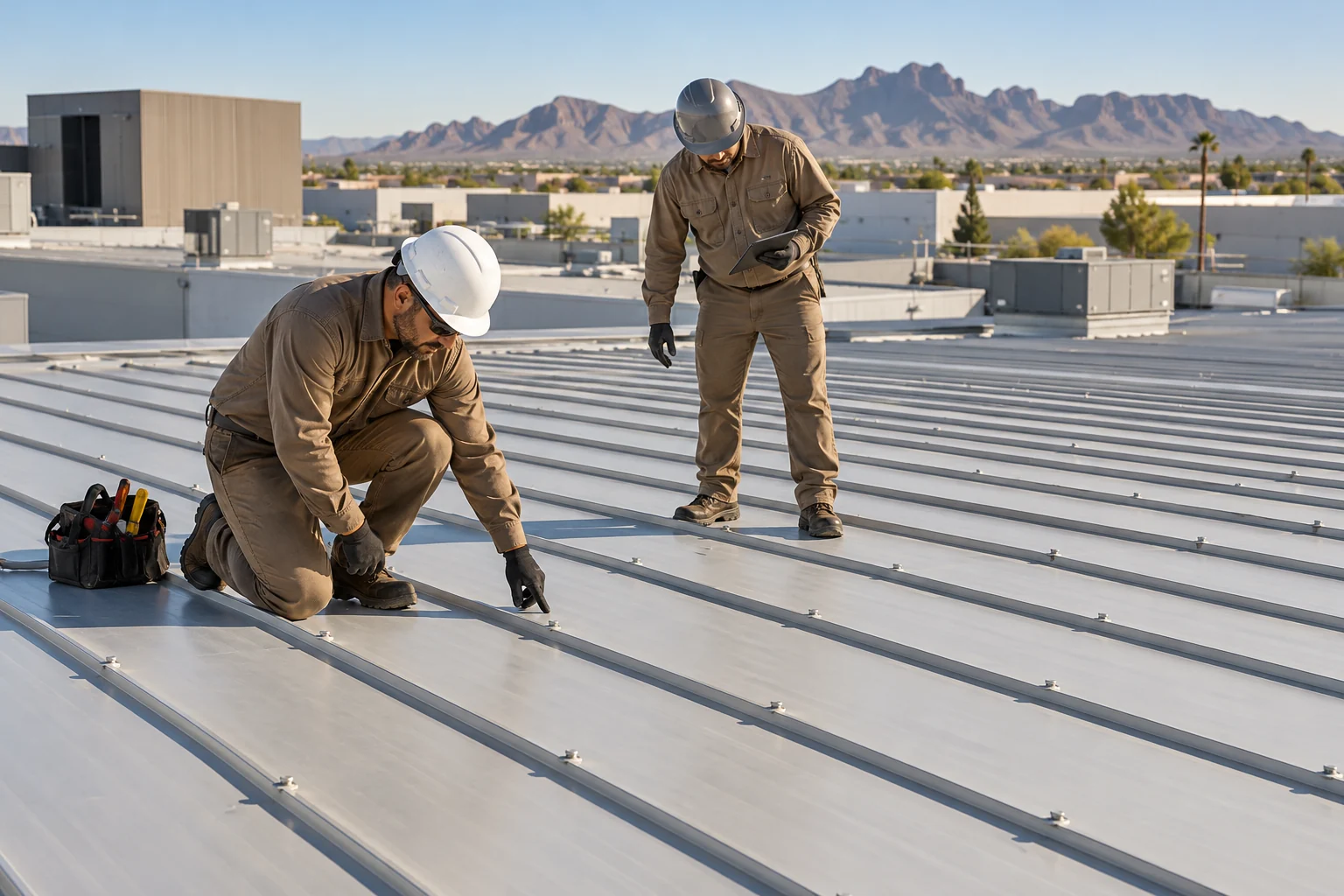
Find The Defect In The Metal Assembly
A leak may involve a panel lap, fastener location, flashing or damaged metal. We examine the relevant area and surrounding construction to understand the likely entry path. The location of water inside helps direct investigation but is not proof of the exact defect.
Previous sealants and patches can obscure the original detail. Their condition and compatibility need review before additional material is applied.
Repair Attachment And Connections
Loose or deteriorated fasteners require attention to their attachment, not only a coating over the head. Open laps and equipment transitions likewise need a repair suited to their construction and movement.
Where the detail is unsuitable or damaged, replacement may be more appropriate than adding sealant. The repair should connect to serviceable components so the original weakness is not left beneath it.
Evaluate Corrosion And Panel Damage
Surface corrosion and metal that has lost useful strength are different conditions. Severe deterioration may require panel replacement. Coating cannot recreate missing metal or correct a weakened support.
Where panels remain sound, localized repairs may preserve much of the existing roof. A broader restoration can be considered separately if the roof condition supports it; it should not be used to avoid correcting the immediate defect.
Assess The Connection Beneath Old Sealant
Repeated applications of sealant can obscure the original condition at a lap or fastener. The assessment should determine whether the underlying connection remains suitable. A new surface layer may look complete while leaving loose attachment or damaged metal untouched.
Preparation may include removing material that no longer adheres or that is incompatible with the planned repair. This does not mean every previous repair must be stripped automatically. It means the retained surface should be a deliberate part of the repair approach.
Panel profile and adjoining construction also matter. A flashing at a wall or equipment opening needs to suit the way the roof is built. A repair that bridges an unsuitable gap with more sealant may remain vulnerable because the basic connection was never corrected.
Where corrosion is present, the scope should distinguish treatable surface condition from metal that has lost useful strength. Severely deteriorated areas may require replacement before a weather-resistant detail can be established. Coating cannot recreate missing material.
If water has affected layers beneath the metal, that condition also belongs in the assessment. A surface repair can address entry without resolving wet or damaged material below. Investigation helps establish the full local scope rather than only the visible roof finish.
Questions About Metal Roof Repairs
Can one panel be replaced while others remain? It may be possible when the connections and adjacent material support the work. The replacement must integrate with the existing roof rather than create an unsuitable transition. Inspection determines the practical boundary.
Will tightening a fastener solve every leak at that point? The surrounding metal, attachment and seal condition also matter. The repair should address the actual defect rather than assume one action fits every fastener concern.
Can rust be covered with coating? Appropriate preparation may be part of restoring suitable metal, but severe deterioration requires another remedy. The assessment should not confuse a new appearance with restored strength.
What if a leak appears only under certain conditions? Describe when it occurs and where water is visible inside. Those observations can help guide investigation of laps, penetrations and other details. They do not replace inspection of the actual roof.
Can a metal roof repair be followed by restoration? A qualifying roof may support coating after required repairs and preparation. The immediate defect should be corrected first, and restoration suitability should be evaluated separately rather than assumed.
How should new equipment openings be handled? Coordinate a suitable roof detail for the completed installation. A cut opening with an improvised surface seal can create a new problem even on an otherwise sound roof.
Begin the request with the commercial address and concern. Roof area alone does not establish the repair cost; panel condition, details, access and affected material determine the work.
Get A Free Estimate
Describe the leak or visible concern, the commercial building location and any access restrictions. An assessment determines the repair area, material needs and whether adjacent components also require attention.
On a roof with several panel sections, water may reach a defect from an adjoining area. The assessment should consider the relevant laps, transitions and outlets rather than isolate the first visible opening. A suitable repair can remain localized while the investigation examines a wider area to establish the source and the condition of the connections surrounding it.
Include any planned equipment changes that could affect the repaired detail.